

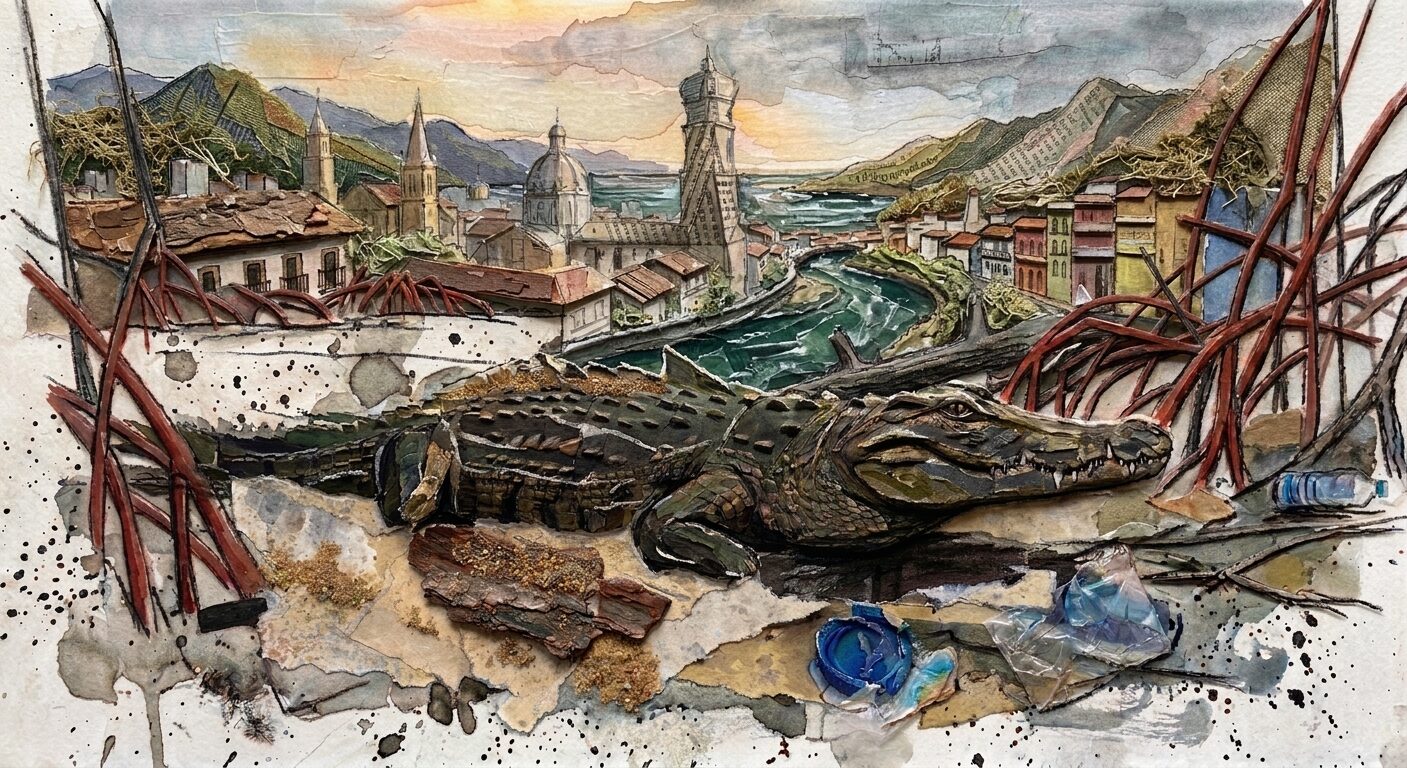
Crocodiles and the Coast: Puerto Vallarta's Uneasy Summer
A fatal attack, unexplained crocodile deaths, and a city confronting a decades-old coexistence problem.
If you’ve seen the recent videos, it’s easy to think we’re being invaded—crocodiles on the beach, in the canals, even near hotels. White sand and pool chairs make it feel like the wild should be far away.
Then, on June 26th of 2026, a 28-year-old visitor died after a crocodile attack near Marina Vallarta. The public reaction was immediate and understandable: there are too many crocodiles, they are getting closer, and someone needs to control them. Someone lost their life.
By August 10, Tribuna de la Bahía reported that Semadet had counted 11 dead crocodiles in the region. The reasons for their deaths were still unknown. Saying that every death was caused by retaliation is just as careless as claiming that one fatal attack means crocodiles are taking over. Profepa warned that harming, capturing, or killing a protected crocodile is a federal crime.
The idea of “too many crocodiles” is tempting because it’s simple. It gives us someone to blame, an easy solution, and the hope that the problem will go away if we just get rid of them. That seems like the end of the story.
However, historical evidence suggests this narrative is difficult to accept.
Before the hotel zone
A 1621 colonial account of the Valle de Banderas described “many caimans” in its rivers. The term predates modern species identification, but not the larger point: crocodilians were not occasional visitors here.
By 1861, a whaling ship had documented American crocodiles, Crocodylus acutus, in Banderas Bay, noting their presence and abundance along local beaches and a nearby river.
Between the 1930s and 1960s, people hunted crocodiles on the Jalisco coast for their skins, which were sent to the United States and Germany. When Mexico banned hunting in 1970, the trade stopped and crocodile numbers started to grow again.

Meanwhile, Puerto Vallarta was being discovered. The airport opened in 1962, and the 1963 filming of The Night of the Iguana brought the town international attention. In the decades that followed came roads, resorts, golf courses, marinas and housing developments that remade the coast.
It was not exactly an easy comeback. Crocodiles were recovering into a landscape with less room to move through mangroves, channels, river mouths and lagoons without running into people.
The space between us got smaller
El Salado puts a number on that change. In 1958, the estuary covered roughly 320 hectares. By 2000, the protected remnant measured 168.9 hectares: a reduction of about 151 hectares, or 47 percent of its 1958 area.
That doesn’t explain every sighting. But it does show why “there are crocodiles where people are” is only part of the story. When the rains come, waterways knit themselves together again and crocodiles slip through; often along routes that now trace the edges of resorts, golf courses, roads, marinas and homes.
That makes real estate part of this story, too. Not because every hotel, home or development is the villain, but because every decision about where and how to build changes the distance between people, water and wildlife.
So… are there too many crocodiles?
I get the reflex because I’ve had it myself. More than fifteen years ago, near the Marietas, I spotted a crocodile and immediately thought: That does not belong here. I was spooked, kept my distance, and for one brief moment, caught myself wanting to speak to nature’s manager.
That feeling is understandable. It is not proof that the animal was out of place.
There is no public evidence for a crocodile “plague.” The best-known local research estimated about 227 crocodiles of all sizes across Banderas Bay’s estuaries and water bodies. More recent state statements cite roughly 300 to 350 animals for a broader regional area. Those figures are not apples-to-apples: they come from different years, cover different areas and likely use different size categories.

More sightings do not automatically mean a crocodile boom. They can also mean less habitat, more people near the water, rainy-season movement, and the fact that every encounter now gets filmed and posted online.
That is not just an inference. Dr. Pablo Simitrius Hernández Hurtado, who heads the University of Guadalajara’s Reptilario Cipactli, says urban growth and land-use change have altered ecosystem dynamics, shifting crocodile movement patterns and increasing sightings in places where they were once less common.
The risk is real. So is the pattern.
American crocodiles are large wild predators. A serious encounter can be catastrophic. By 2010, researchers had documented 30 to 31 attacks along the Jalisco coast over 52 years, including three fatalities between 1958 and 2007.
The risk isn’t random. Nearly all documented conflicts happened in the water, in places crocodiles are known to live. This isn’t about blaming victims—it’s about making risk visible before people get in the water.
A safe coast doesn’t promise wildlife-free beaches. It tells people where not to swim and why, closes access when conditions demand it, gives everyone up-to-date information, and treats warning signs as just one part of the safety system.
No single villain. No single fix.
The crocodile, the nearest hotel, the latest development, and the official holding a warning sign all make easy suspects. None gets a free pass. Crocodiles can be dangerous. Growth has carved up habitat. Waterfront businesses must communicate risk, and authorities need to act before tragedy becomes the only reason to start.
No single culprit explains the conflict, and no single fix will solve it. Removing one animal does not restore a corridor. Blaming one project does not create real-time monitoring. And a warning sign alone cannot tell a visitor whether conditions changed after a storm, or who is responsible for acting when they do.
What safer coexistence actually requires
Puerto Vallarta doesn’t need to copy anyone’s playbook. Florida mostly manages alligators. Queensland handles saltwater crocodiles under different laws. The real lessons are simpler: active monitoring, clear and dynamic risk zones, public education, enforceable protocols, and selective action based on evidence, not every sighting.
For Puerto Vallarta and Bahía de Banderas, that means an up-to-date public map of sightings and closures; beach checks after heavy rain and at higher-risk times; trained hotel and beach staff; clear escalation protocols; and tracking repeat-risk animals. It also means protecting wetland connections before approving new projects, and enforcing rules against feeding, harassing or killing a protected native species.
Should you be worried?
Not everywhere. But in the wrong place, at the wrong time, absolutely.
American crocodiles are large wild predators, and the risk is real near estuaries, river mouths, canals and other known habitat.
- Do not enter the water near an estuary, canal or river mouth, especially after heavy rain or when access is closed.
- Respect beach flags, closures and lifeguard instructions.
- Never feed, approach, touch or try to move a crocodile.
- If you see one, leave the water’s edge, give it space and report suspected harm, capture or illegal possession to Profepa: 800-PROFEPA (800 776 33 72).
Safety is not the absence of crocodiles. It is a city that knows where the risk is, communicates it honestly and stops making the underlying conflict worse.

The future of this bay will not be decided by whether we are more afraid of crocodiles or more protective of them.
It will be decided by whether we are finally willing to build and govern as if the wetlands beneath this city are still alive.
Ale Santibáñez, Puerto Vallarta — August 2026